
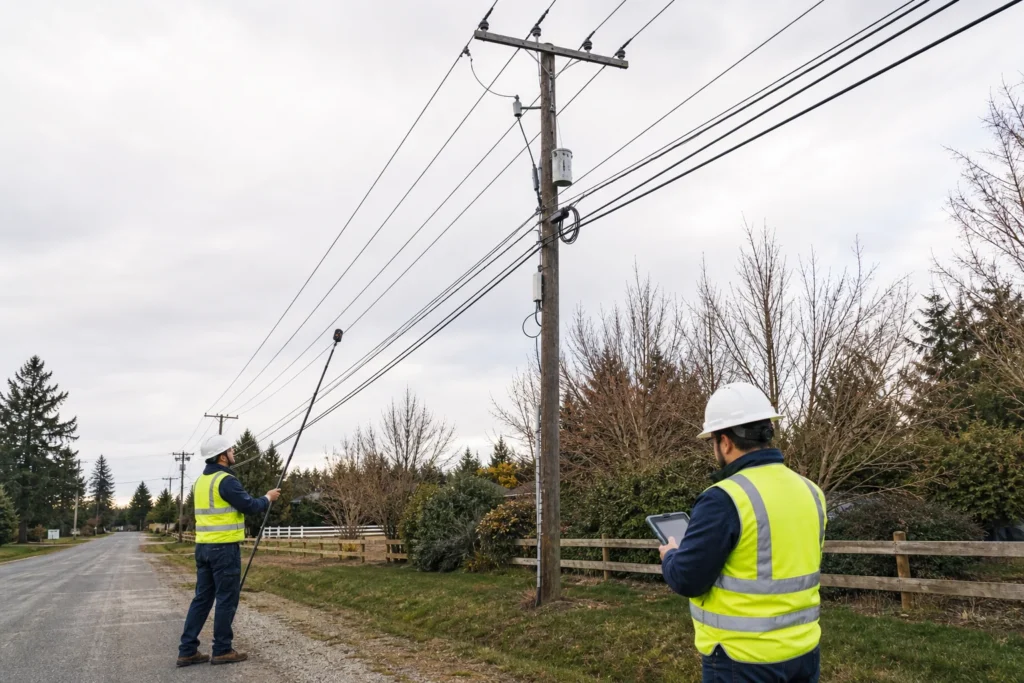
Visual note: this AI-generated editorial image illustrates the engineering context. It does not show a client, site or completed Geospatial Net project.
Aerial broadband deployment can look simple on a route map and become difficult one structure at a time. The governing question is not merely whether a proposed cable follows a pole line. A reviewer needs to know whether each pole is correctly identified, whether the field evidence is complete, which attachments and spans are present, which owner rules apply, how the proposed attachment changes the condition and what engineering approval is required.
A useful pole workflow connects those questions instead of handing them between survey, GIS, design, structural analysis and permitting as separate files. The objective is a reviewable evidence chain-not a faster way to move uncertain records into a calculation tool.
Start with the authority, not the measurement form
Before field collection, confirm the pole owner, jurisdiction, application process, governing construction and loading criteria, accepted measurement methods, required software or calculation format and the person or organisation authorised to approve the result. Requirements can differ by owner and location. A field schema copied from another programme can collect precise data that is still unusable for the current review.
The standards register should identify the source, version, effective date, applicability and accountable reviewer. It should also separate mandatory requirements from internal preferences. This gives survey and engineering teams one place to resolve changes rather than applying different assumptions across work packages.
Build a pole record that can survive review
Each structure needs a stable project identifier connected to the owner identifier where one exists. Typical evidence may include pole material, class, height, circumference, installation or treatment information, condition observations, coordinates, ground-line context, attachment elevations, equipment, guys and anchors, span directions and lengths, photographs and measurement method. The required set must follow the approved scope.
Source and confidence matter as much as the value. An owner record, a field observation, a value derived from imagery and an engineering assumption should not look identical in the database. Recording source, date, operator, device or method, review status and exception reason lets the team separate analysis-ready structures from those requiring recapture or clarification.
Keep existing and proposed conditions separate
The existing structure record should not be overwritten by a proposed design. Model the current attachments, the proposed attachment and any anticipated transfers, rearrangements, guying or replacement as related but distinct states. This makes it possible to explain what changed, which recommendation depends on which assumption and what the construction team is expected to deliver.
Geometry also needs context. Attachment height, span, cable characteristics and equipment are not isolated fields; they belong to a structure-and-span model. A GIS can manage location and relationships, while the approved engineering workflow evaluates the governing structural and clearance questions.
Use an exception queue before analysis
Do not force every pole through the same pipeline. Validate identity, required fields, units, plausible ranges, span relationships, image coverage and conflicting sources first. Structures with missing class, uncertain height, unverified equipment, incomplete spans or non-standard conditions should enter a visible exception queue with an owner and next action.
This separation protects engineering time. It also gives programme managers a truthful measure of progress: surveyed, data-complete, analysis-ready, under review, make-ready defined, approved, constructed and As-Built are different states.
Connect make-ready recommendations to evidence
A make-ready schedule should identify the structure, proposed action, responsible party, dependency, supporting analysis, review status and construction or permit reference. Transfer, rearrangement, replacement and route-alternative recommendations should remain linked to the field condition and proposed attachment that produced them.
Where a licensed or pole-owner-approved engineer must certify calculations or recommendations, the workflow must name that authority explicitly. Data preparation and analysis support do not substitute for required professional approval.
Close the loop after construction
Permit approval is not the end of the asset record. The same identifiers should connect construction completion, field changes, final attachment position, photos, unresolved exceptions and operational GIS updates. When the As-Built process uses a different pole list, the programme loses the evidence it worked to assemble during application.
Geospatial Net’s pole loading and make-ready support connects field inventory, GIS, controlled analysis inputs, exception handling and documentation. It can sit beside FTTx planning and As-Built delivery as one traceable aerial-network workflow.
Engineering takeaway
A pole-loading programme is credible when a reviewer can follow each structure from governing rule and field source through existing condition, proposed attachment, analysis status, recommendation, approval and final update. Speed comes from separating ready work from uncertainty-not from hiding missing data.
Decision checklist
- Which owner, jurisdiction, standard version and approval authority govern the work?
- Can every measurement be traced to a structure, source, date and method?
- Are existing, proposed and make-ready states modelled separately?
- Which structures are analysis-ready, and who owns every exception?
- How will approvals and construction changes update the same GIS record?
Sources and engineering references
- FCC 18-111: pole attachment and one-touch make-ready order – US regulatory context for surveys, make-ready and pole access.
- FCC 2026 pole-attachment public notice – current US policy context for state regulation and deployment.
- NTIA BroadbandUSA permitting resources – federal broadband permitting and environmental-review context.