
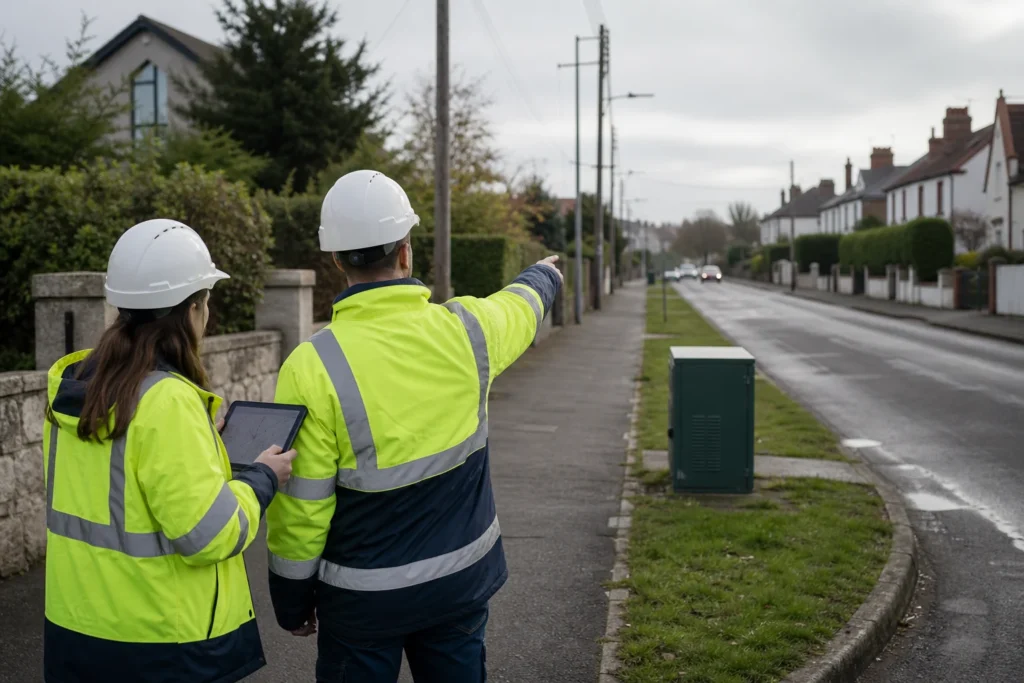
Visual note: this AI-generated editorial image illustrates the engineering context. It does not show a client, site or completed Geospatial Net project.
Artificial Intelligence (AI) is stepping into the world of FTTx (Fiber to the X) planning, a field traditionally dominated by human know-how. While the unique insights of professionals remain irreplaceable, AI is beginning to play a supportive role, promising to make telecom networks not only smarter but also more efficient.
Bridging Human Expertise with AI
FTTx planning is complex, requiring a level of precision that only human experts have been able to provide. However, AI is starting to make its mark, offering a helping hand in several key areas:
- Smarter Data Analysis: AI excels at analyzing data, effortlessly transforming complex information into clear insights. AI models can be used for predictive analytics before investing in an area, aiding in market understanding. Additionally, throughout all stages, they assist experts in timely updating documentation with more accurate information and identifying patterns where specific topologies might be unsuitable or certain equipment may be prone to faults.
- Streamlining Surveys: AI, through Spatial Analysis Models (SAM), scans images to precisely identify telecom infrastructure, making surveys quicker and more accurate. Existing models can already recognize infrastructure from images, optimizing survey costs and providing valuable data for future use.
- Ahead of the Curve Planning: With the latest plugins and models used by GIS packages, AI shows great promise in detecting changes in satellite imagery that would typically take humans much longer. It can identify impending construction projects, giving telecoms an early warning. This proactive strategy allows for early planning and budgeting, ensuring networks remain flexible and adaptive.
- Predictive Upkeep: AI has an eye for spotting potential trouble spots, from vegetation encroaching on cables to infrastructure at risk from weather or wear. This foresight allows for maintenance to be scheduled in advance, averting issues before they disrupt service.
- Optimizing Routes: Beyond planning, AI also refines maintenance routes for peak efficiency and anticipates potential failures or areas where costs may spike, ensuring resources are used wisely and effectively.
Bridging Human Expertise with AI
FTTx planning is complex, requiring a level of precision that only human experts have been able to provide. However, AI is starting to make its mark, offering a helping hand in several key areas:
- Smarter Data Analysis: AI excels at analyzing data, effortlessly transforming complex information into clear insights. AI models can be used for predictive analytics before investing in an area, aiding in market understanding. Additionally, throughout all stages, they assist experts in timely updating documentation with more accurate information and identifying patterns where specific topologies might be unsuitable or certain equipment may be prone to faults.
- Streamlining Surveys: AI, through Spatial Analysis Models (SAM), scans images to precisely identify telecom infrastructure, making surveys quicker and more accurate. Existing models can already recognize infrastructure from images, optimizing survey costs and providing valuable data for future use.
- Ahead of the Curve Planning: With the latest plugins and models used by GIS packages, AI shows great promise in detecting changes in satellite imagery that would typically take humans much longer. It can identify impending construction projects, giving telecoms an early warning. This proactive strategy allows for early planning and budgeting, ensuring networks remain flexible and adaptive.
- Predictive Upkeep: AI has an eye for spotting potential trouble spots, from vegetation encroaching on cables to infrastructure at risk from weather or wear. This foresight allows for maintenance to be scheduled in advance, averting issues before they disrupt service.
- Optimizing Routes: Beyond planning, AI also refines maintenance routes for peak efficiency and anticipates potential failures or areas where costs may spike, ensuring resources are used wisely and effectively.
AI and FTTx: A Future Powered by Innovation
Despite AI’s advancements, FTTx planning is a specialty where human judgment shines. AI’s role, for now, is to augment and enhance this judgment, especially in tasks like analytics, surveying, and maintenance.
- Rapid Data Crunching: AI’s ability to quickly process and analyze data-from how customers use networks to overall network health-provides invaluable insights that guide strategic decisions.
- Efficient Surveying: Automating the identification of key infrastructure through imagery not only cuts down survey time but also allows planners to concentrate on the bigger picture.
- Staying One Step Ahead: AI’s predictive power means telecoms can foresee and prepare for changes and maintenance needs, keeping networks robust and responsive.
- Savvy Maintenance and Resource Management: AI doesn’t just predict problems; it suggests the most efficient maintenance schedules and resource allocations, ensuring networks operate smoothly and cost-effectively.
In essence, AI is gradually becoming a pivotal tool in FTTx planning, offering solutions that complement the depth of human expertise. As AI technology continues to evolve, its role in telecom will undoubtedly expand. However, the nuanced understanding and strategic planning of seasoned professionals remain central to FTTx planning. Together, AI and human insight are setting the stage for a future where telecom networks are more reliable, efficient, and primed to meet the challenges of tomorrow.
Engineering takeaway
AI is useful when it supports a defined engineering decision with known inputs, test cases, error limits and human review. It should not hide weak source data or become an unreviewed route, quantity or acceptance authority.
Decision checklist
- Which bounded decision or review queue will the model support?
- What representative evaluation set and baseline will be used?
- Which errors matter and who reviews low-confidence cases?
- How are version, monitoring, incident response and stop authority handled?
Sources and engineering references
- NIST: AI Risk Management Framework – Voluntary guidance for managing risks across AI design, deployment and use.
- European Commission: European approach to artificial intelligence – Current regulatory overview for AI systems in the European Union.
Official and standards links provide source context; they do not imply endorsement, legal advice or project acceptance. Confirm current rules, access conditions, licence and fitness for the specific jurisdiction and decision.